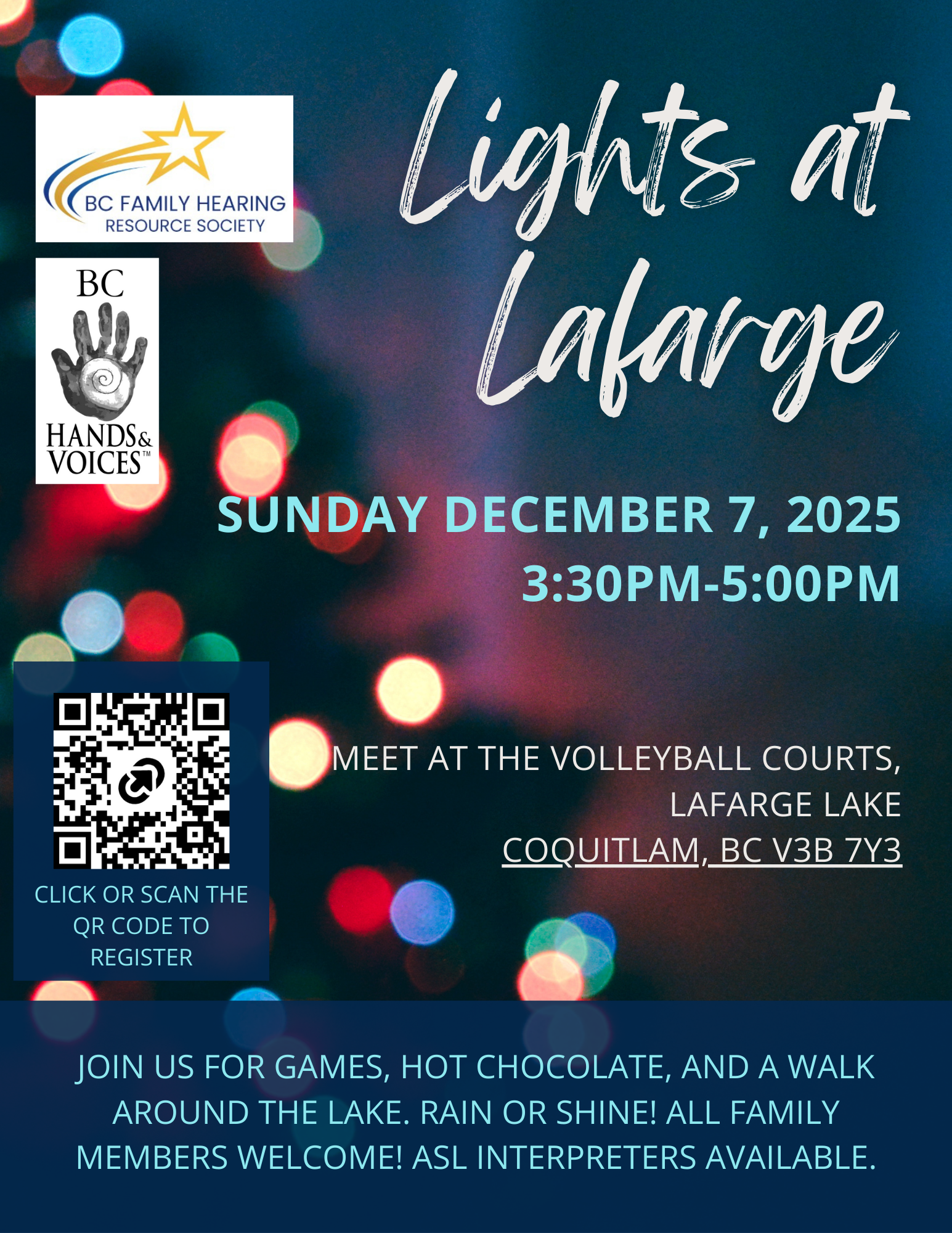
Lights at the Lake 2025

Gather the whole family and join us for games, hot chocolate, and a walk around the lake. This event is going ahead rain or shine so dress for the weather. ASL Interpreters will be present. This event is jointly hosted with BC Family Hearing Resource Society.

REGISTER HERE: https://tinyurl.com/2mvv4fw9
Download our flyer here: Flyer-Lights at Lafarge 12.2025

Posted in Events, Uncategorized | Leave a comment

Honouring Deaf Children’s Society of BC’s Legacy and Supporting Families Forward

From the Board of BC Hands & Voices

As parents and members of the Deaf and Hard of Hearing community, we at BC Hands & Voices want to acknowledge the recent closure of the Deaf Children’s Society of BC (DCS BC) and reflect on its impact.

After nearly 50 years of supporting families with children who are Deaf, Hard of Hearing, or DeafBlind, DCS BC has made the difficult decision to dissolve the organization, as confirmed during their Extraordinary General Meeting on October 29, 2025.

We celebrate the remarkable legacy that DCS BC leaves behind and the incredible community of families and professionals who will carry this important work forward. With gratitude for all that has been accomplished, we look ahead with hope and pride in the continued impact of their work.

Honouring the Heart of DCS BC

Since its founding in 1975, DCS BC has stood out for being Deaf-led and for championing a bilingual-bicultural approach supporting early language access through both American Sign Language (ASL) and English. It prioritized Deaf cultural identity and built a space where families could feel seen, heard, and supported, often from the earliest days of identification or discovery.

As a board of parents/caregivers and professionals, many of us have been supported through the ripple effects from the DCS BC community, whether through direct service or by their nurturing of the many talented Deaf professionals working in our communities.

To the staff, Deaf mentors, educators, board members, and volunteers, our sincere thank you. Thank you for visiting our homes. Thank you for your warmth at community events. Thank you for teaching some of our children their first signs. Thank you for showing us what’s possible.

Your advocacy, commitment, and heart changed lives. It will continue to guide how we, as families, support and empower children.

For more information, you can read their official announcement and meeting minutes on the DCS BC website: http://www.deafchildren.bc.ca 

What This Means for Families

While this marks the closing of DCS BC, the support for Deaf, Hard of Hearing, and DeafBlind children in BC continues. 

Families who were receiving support from DCS BC should have already been contacted with guidance on transferring services to the following agencies which will ensure families have the guidance, resources, and therapy needed for their child’s development and success:

These services include speech and language therapy, ASL instruction, language assessments, parent mentoring, and connection to a broader community of families and professionals. If you have questions about your services being transferred, please reach out to the organizations above.   

The following organizations are also available to provide support services, and we encourage parents to visit these websites or contact them directly to learn more about how they may assist your family: 

Moving Forward, Together

We know that change can feel uncertain, but the legacy of DCS BC and the importance of early access to language and Deaf/Hard of Hearing role models will carry on through so many who are dedicated to successful outcomes for deaf/hard of hearing children.

At BC Hands & Voices, we remain committed to creating space for families to connect, to share and to learn about the many opportunities available to support what our children need to thrive both now and in the future.

To everyone who shaped DCS BC: thank you. You’ve made a lasting mark. And to every parent wondering what happens next: we’re here with you.

With gratitude,
The Board of BC Hands & Voices
info @ bchandsandvoices.com

Posted in Articles | Leave a comment

BCHV Summer Get-Together 2025 

By Sarah Francescutti

This summer’s BCHV family gathering at Confederation Park in Burnaby on 16 August 2025 was such a joy! About 40 parents and children joined us for a dry afternoon of connection, laughter, and play. We almost considered cancelling as there was rain elsewhere but fortunately it stayed dry at the park. 

Families spread out picnic blankets, splashed in the water park, and shared stories and smiles. The park’s open green spaces, shaded picnic area, and nearby playground made it the perfect spot for little ones to explore and families to relax.

The goal of this annual event is simple but powerful: to bring together families raising children who are Deaf or Hard of Hearing (DHH) in a welcoming, inclusive space. It’s a chance to meet others who understand the unique joys and challenges of the journey, and share lived experiences. It lets our children see that they are not alone and gives them the opportunity to see that there are other kids just like them, to play together and make new friends.

I was thrilled to travel over from Victoria for the event and meet some new Lower Mainland families in person. As a parent, it’s always so meaningful to connect with others walking a similar path, to exchange ideas, share stores, celebrate milestones, and build friendships that extend beyond the day. My daughter especially loved meeting other kids who also wear equipment, and of course, the highlight for both of us was the miniature train ride that winds through the park’s trees, a favourite for kids (and parents!) every year.

Thank you to everyone who came out to make the day so special! Thank you to our ASL interpreters, students and BCHV and Guide by Your Side volunteers for helping everything run smoothly.

If you missed this year’s event due to weather or a busy summer calendar, no worries, we hold it every year! We’d love to see you at next summer’s get-together for another day of family fun, community connection, and shared joy.

Stay tuned to our BC Hands and Voices Facebook page for updates and future event announcements!


Posted in Articles, Events, Families to Families | Comments Off on BCHV Summer Get-Together 2025 

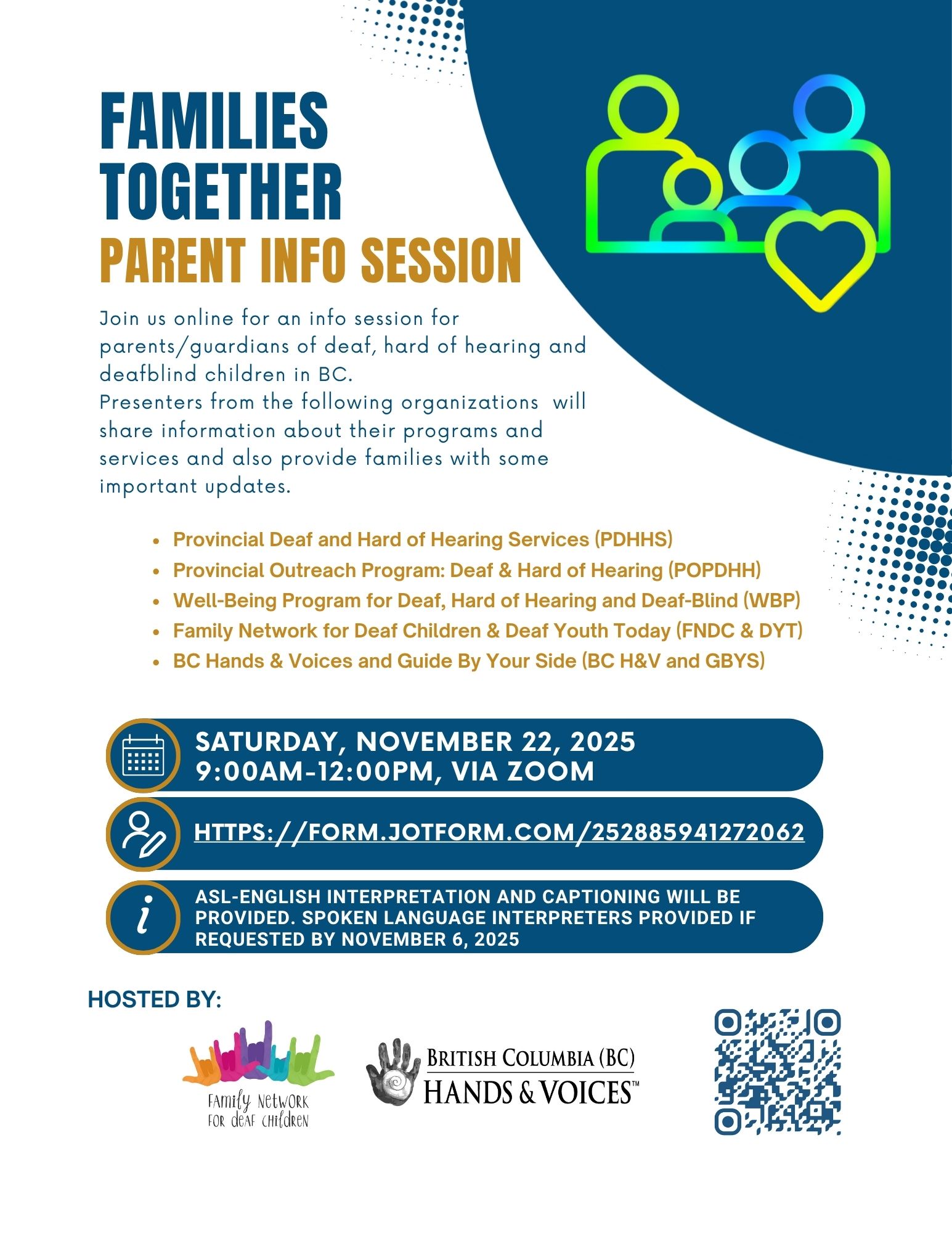
Families Together: Parent Info Session 2025

WHO: Family Network for Deaf Children & BC Hands & Voices
WHAT: Join us online for an info session for parents/guardians of deaf, hard of hearing and deafblind children in BC. Presenters from the following organizations will share information about their programs and services and also provide families with some important updates.

  • Provincial Deaf and Hard of Hearing Services (PDHHS)
  • Provincial Outreach Program: Deaf & Hard of Hearing (POPDHH)
  • Well-Being Program for Deaf, Hard of Hearing and Deaf-Blind (WBP)
  • Family Network for Deaf Children & Deaf Youth Today (FNDC & DYT)
  • BC Hands & Voices and Guide By Your Side (BC H&V and GBYS)

ASL-English interpretation & captioning will be provided. Spoken language interpreters will be provided if requested by November 6th.
WHEN: Saturday November 22, 9:00am-12:00pm
WHERE: online via Zoom
REGISTER: https://form.jotform.com/252885941272062
Zoom details will be shared once registered.

Download our flyer here: Parent Info 11.22.2025

Posted in Advocacy, Events, Families to Families | Comments Off on Families Together: Parent Info Session 2025

The Role Music Plays in the Development of Deaf/Hard of Hearing Children

I don’t have a musical bone in my body so when I thought of what I wanted for my children, I knew I wanted music to play a part. When my eldest child was born deaf, I wasn’t sure what that would look like but I was still determined to have music be a part of her world. As a toddler we attended special music programs for young children and I was lucky that music programming was a very important part of her preschool education. I enrolled her in piano lessons at age 5 and she quickly picked it up. She still plays joyfully 10 years later. I know in my heart that it’s played a significant role in her development and in her identity. I interviewed her for this article.

What were your first memories of music as a younger child?

  • I remember music was a big part of my preschool years, songs for cleaning up for example. I also remember I loved to sing all the songs from Frozen.

What role does music play in your family, school, or community growing up?

  • I play the piano, I started when I was 5 years old. I really love it, it calms me. And whenever I learn a new piece, I feel proud. Sometimes it takes me longer but it always feels great when I can play my favourite songs. I also like to learn songs on my own without sheet music. It’s great to enjoy music as notes only, and not focus on lyrics.
  • My family likes to sing a lot, sometimes together in the car. There’s a lot of music that makes me feel happy or emotional.

Do you think you experience music differently than others?

  • The way I experience music is a bit different to my hearing friends. They can hear all the music/instruments without trying but I have to pick apart the instruments and really focus. Sometimes my friends can’t hear the specific parts of the music that I can, which is interesting.

What has made music accessible for you (e.g., visual cues, vibrations, captioned lyrics, signed songs)?

  • My hearing aids, and being able to stream directly into them. This amplifies the sound and allows me to hear more parts of the music. I also like reading the lyrics while listening to music. Signed music is incredible! I love watching that too. 


Is there a memory or moment with music from your childhood that stands out as especially meaningful?

  • This summer I went to my first concert! It was really cool because I could hear the bass and the vibrations in my chest! It was amazing to experience my favourite songs live with thousands of other people. 

Music is something deeply personal to each individual and how it’s enjoyed and experienced has endless possibilities. I hope your dhh child finds their own musical experience!

Here are several sources & studies that report benefits of music, rhyme, rhythm etc. specifically for deaf children who use ASL, or more broadly relate to ASL use.

Main Findings / Relevance to ASL Users / Deaf Children Supports Which Benefit Source
A single-subject study comparing ASL stories with rhyme/rhythm versus non-rhymed ASL stories. Found that rhymed/rhythmic ASL stories increased engagement and accuracy in recitation among Deaf children. (PMC) Enhances engagement, supports learning via pattern / memory; helps with fluency in ASL as well as perhaps with literacy when ASL ↔ English bridges are made. Effects of ASL Rhyme and Rhythm on Deaf Children’s Engagement (PMC) (PMC)
Discusses how using rhyme and rhythm in ASL can help develop language awareness (analogous to phonological awareness in spoken languages), e.g. awareness of sign parameters (handshape, movement, location). Suggests that ASL rhyme/rhythm helps with ASL literacy and supports the transition to reading/writing English. (DigitalCommons) Language development, literacy (reading), structure & pattern recognition. ASL Rhyme, Rhythm, and Phonological Awareness for Deaf Children (Perspectives / Pace University) (DigitalCommons)
Found that Deaf children are at risk for delays in executive function (attention, working memory, cognitive control), but that a music‐based training (presumably adapted / accessible) showed improvements in EF skills. (Oxford Academic) Cognitive benefits—attention, working memory, planning etc. which are helpful for both academic learning and language use. Executive Function Training for Deaf Children: Impact of a Music-Based Intervention (Oxford Academic)
This describes programs that expand music definitions (e.g. feeling vibration, visual representation, signing / ASL rhythm/rhyme) in classes for Deaf & hard of hearing students. ASL nursery rhymes are linked with greater literacy skills. They also use Universal Design for Learning (UDL) to make music accessible (for example, with visual, tactile, movement, ASL). (ERIC) Literacy, ASL & English bridging, social-emotional growth, engagement, inclusive learning. The Deaf Music Project / “And the Beat Goes On: Using Music to Transform Classes for Deaf Students” (St. Francis de Sales School / Teachers College) (ERIC)
Qualitative data about how DHH individuals perceive/experience music: what aspects (rhythm, vibration, visual) matter, and how music is meaningful even when hearing is limited. Useful for understanding what adaptations help. (UNI ScholarWorks) Helps inform how to make music accessible (using vibrations, visuals etc.) and the emotional / identity / expressive benefits. Perspectives On Music Within the Deaf and Hard of Hearing (UNI ScholarWorks) (UNI ScholarWorks)
Reports on research / creative practice in which ASL is used as part of musical performance—signed music, performance, and how Deaf artists engage with rhythm, visual rhythm, movement. Shows that music and ASL can co-exist in artistic / expressive ways. (Clemson News) Social, identity, cultural expression, creative benefit. Music for the Deaf Is Not a Contradiction (Clemson News, about ASL & music performance) (Clemson News)
Posted in Articles | 2 Comments

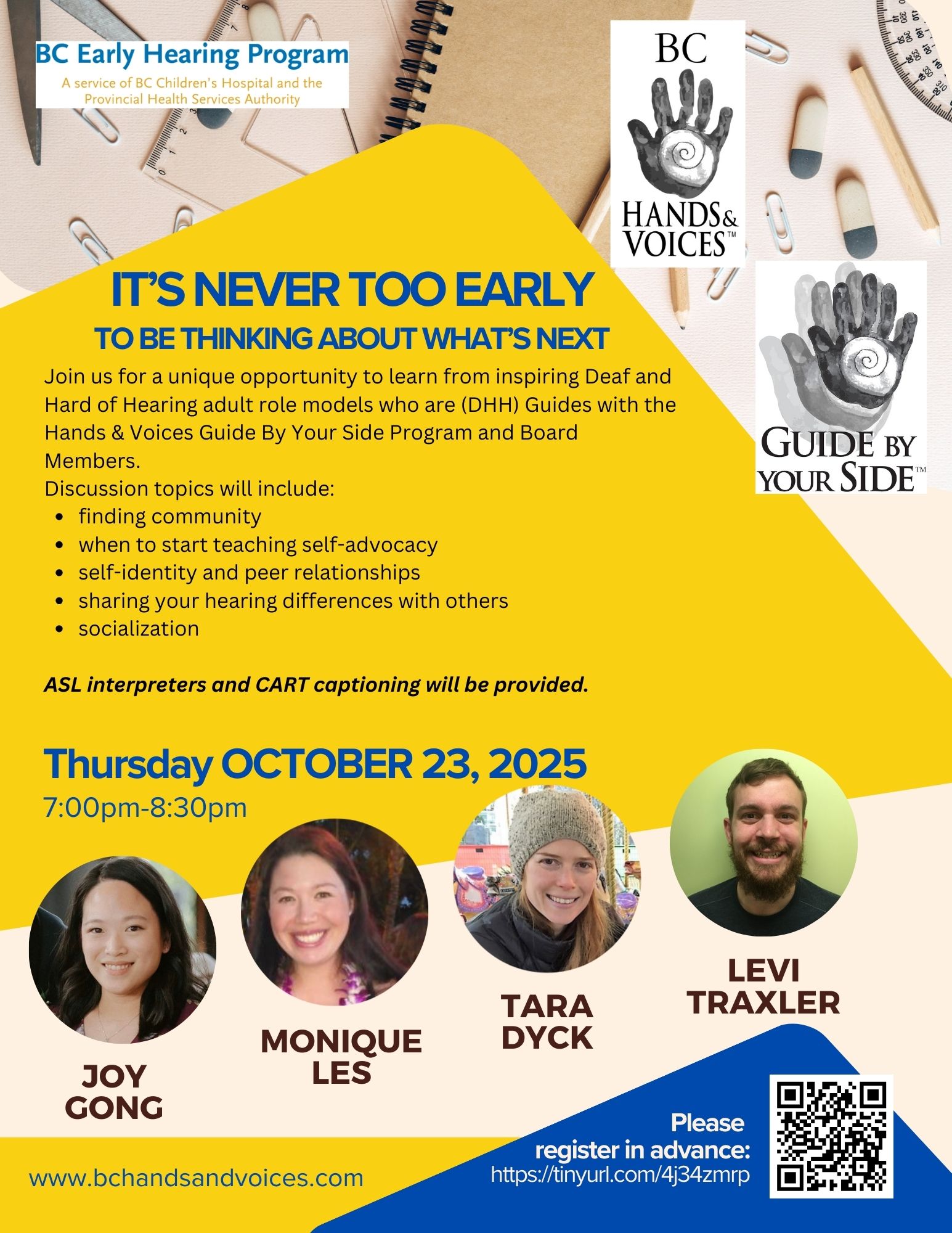
It’s Never Too Early To Think About What’s Next: Learning with Deaf/Hard of Hearing Adults

WHO:BC Hands & Voices, Guide By Your Side, BC Early Hearing Program
WHAT: Join us for a unique opportunity to learn from inspiring Deaf and Hard of Hearing adult role models who are (DHH) Guides with the Hands & Voices Guide By Your Side Program and Board Members. Speakers will share some of their experiences growing up as well as answer any questions you may have. Panelists will share some of their experiences growing up as well as:
-When to start teaching self-advocacy
-Sharing your hearing difference with others
-Finding community
-Self-identity and peer relationships
-Socialization
ASL interpreters and CART captioning will be provided.
WHEN: Thursday October 23, 2025 7:00pm-8:30pm
WHERE: Zoom
CONTACT/INFO: Register here: https://tinyurl.com/4j34zmrp

Download flyer here: DHHG-It’s Never Too Early 10.2025

Posted in Coffee Night, Events | Comments Off on It’s Never Too Early To Think About What’s Next: Learning with Deaf/Hard of Hearing Adults

Supporting a Hard of Hearing Child Through Kindergarten: What I Learned as a Parent

By: Stella Lee

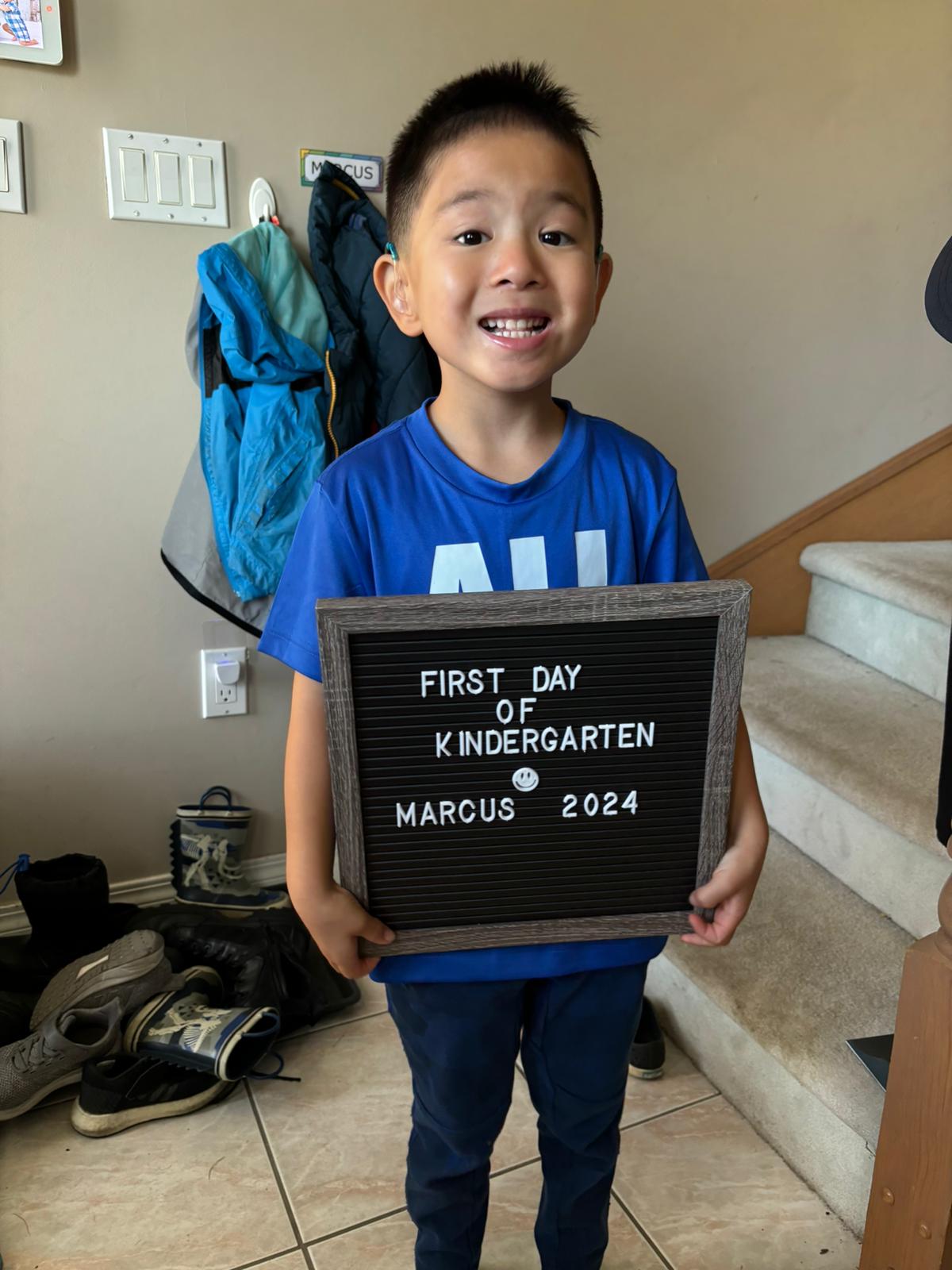
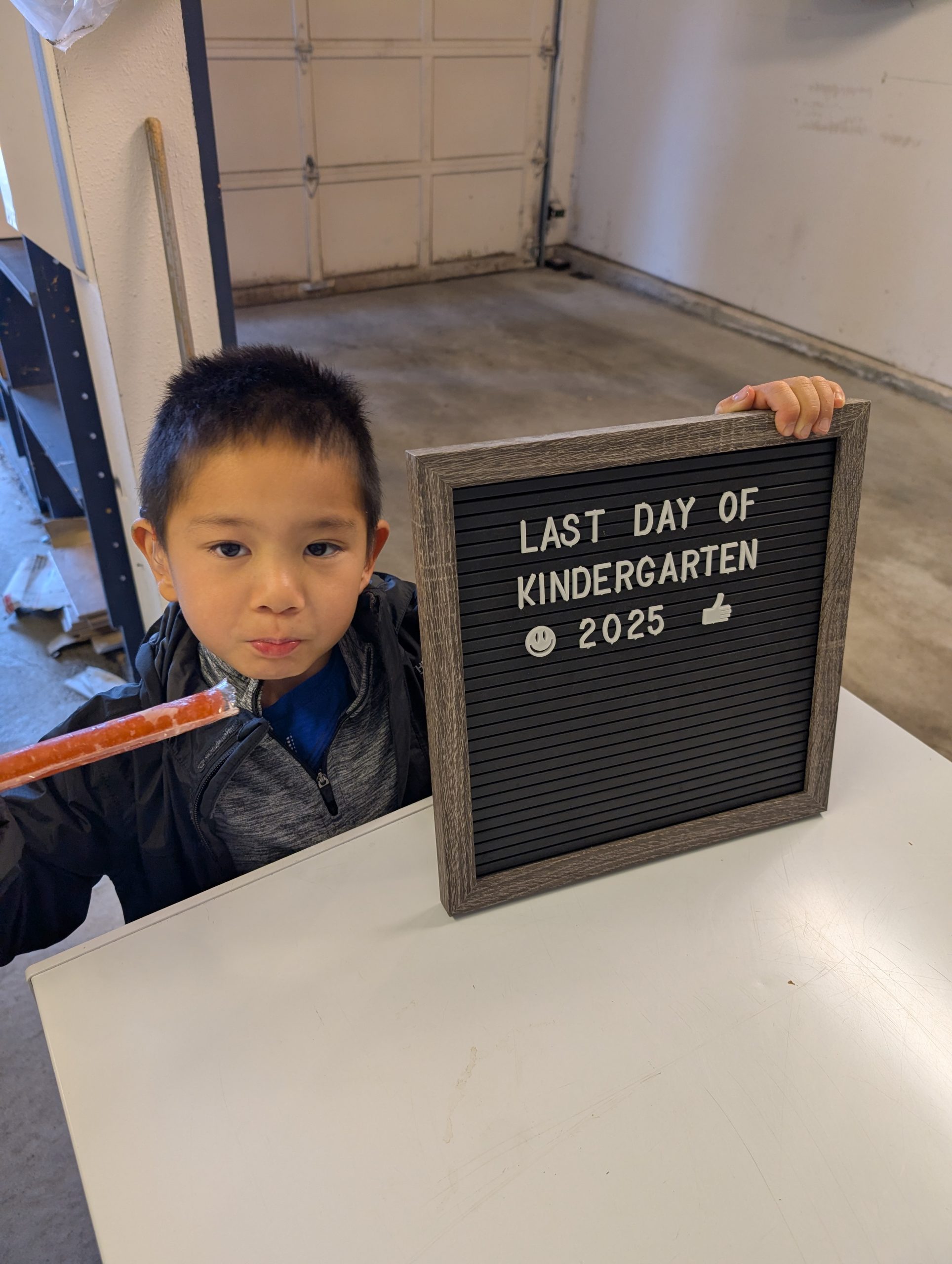
When my son Marcus finished kindergarten in June 2025, I took a moment to reflect on how far he had come—not just academically, but in his ability to advocate for his hearing needs. As a parent of a child who is hard of hearing, this past year has been a journey of learning, adapting, and growing—not only for Marcus, but for our entire family.

Early Preparation and the Power of Support

We were fortunate to receive an FM system in the summer of 2024, ahead of Marcus starting kindergarten. He had the chance to begin using it with daycare staff, which gave him some early familiarity. When it came time to transition into school, I made a specific request: I asked for our Teacher of the Deaf and Hard of Hearing (TDHH) to attend Marcus’ kindergarten intake interview.

That step made all the difference.

Our TDHH was incredible. She ensured the FM system was properly set up and took the time to train the classroom staff on how to use it. This early preparation gave Marcus a strong start, and it reassured me that we were setting the foundation for a successful year.

Building a Collaborative Team

In October, we had our first Individualized Education Plan (IEP) meeting. I was grateful to see both the TDHH and the school-based case manager working together to develop meaningful goals for Marcus. Since Cantonese is Marcus’ first language, he also received English Language Learner (ELL) support, which made a significant impact on his vocabulary and language development.

At one point during the year, I noticed communication between the various support teachers seemed to be going in different directions. Marcus at one point had 3 different support teachers, due to a teacher being on leave, and many were not following the literacy goal set out in the IEP. Instead of letting that continue, I sent a quick email to our TDHH. She responded quickly and helped bring everyone back together and focused on a unified approach for Marcus. That experience taught me that speaking up—even in small ways—can make a big difference.

Celebrating Growth and Small Wins

By the time we reached the year-end IEP review in June, it was encouraging to hear about the progress Marcus had made—both socially and academically. One of the milestones we were especially proud of was how he began learning to advocate for himself. He was still working on consistently remembering to take the FM system with him between classes, but he knew how to speak up when something wasn’t working with his hearing aids or the equipment. For a 5-year-old, that was a huge accomplishment.

Summer Practice and Continued Learning

Marcus attended Burnaby summer school in July, which gave him more practice in managing the FM system independently. As a family, we took it upon ourselves to ensure that the summer school staff knew how to use the equipment. On the first day, we brought the FM system in and reminded Marcus that he was responsible for handing it off to his next teacher after lunch. He managed that perfectly—but we forgot to check if he had it at the end of the day! Thankfully, his afternoon teacher noticed and sent the FM back to the morning teacher.

After summer school, Marcus attended camp through his afterschool care provider. We did have some challenges getting him to consistently wear his hearing aids, but we gave him a bit more responsibility. He knew he could store them in his case and just needed to tell an adult if he chose to take them off. Many of the staff had known Marcus since he was three, which gave us peace of mind—they understood his needs and supported him naturally.

Looking Ahead to Grade 1

As we prepare for Grade 1, I’ve learned that supporting a hard of hearing child is about balancing trust in the system with ongoing advocacy. Sometimes we need to take a step back and let our children grow independently. Other times, we need to step forward and ensure that their needs are being met—whether that’s through communication with teachers, checking equipment, or reminding staff of accommodations.

To other parents walking a similar path: trust your instincts, speak up when something doesn’t feel right, and celebrate the small victories along the way. Your child is learning not just how to hear, but how to be heard—and that’s a lifelong skill worth nurturing.


Posted in Advocacy, Articles, Families to Families | Comments Off on Supporting a Hard of Hearing Child Through Kindergarten: What I Learned as a Parent

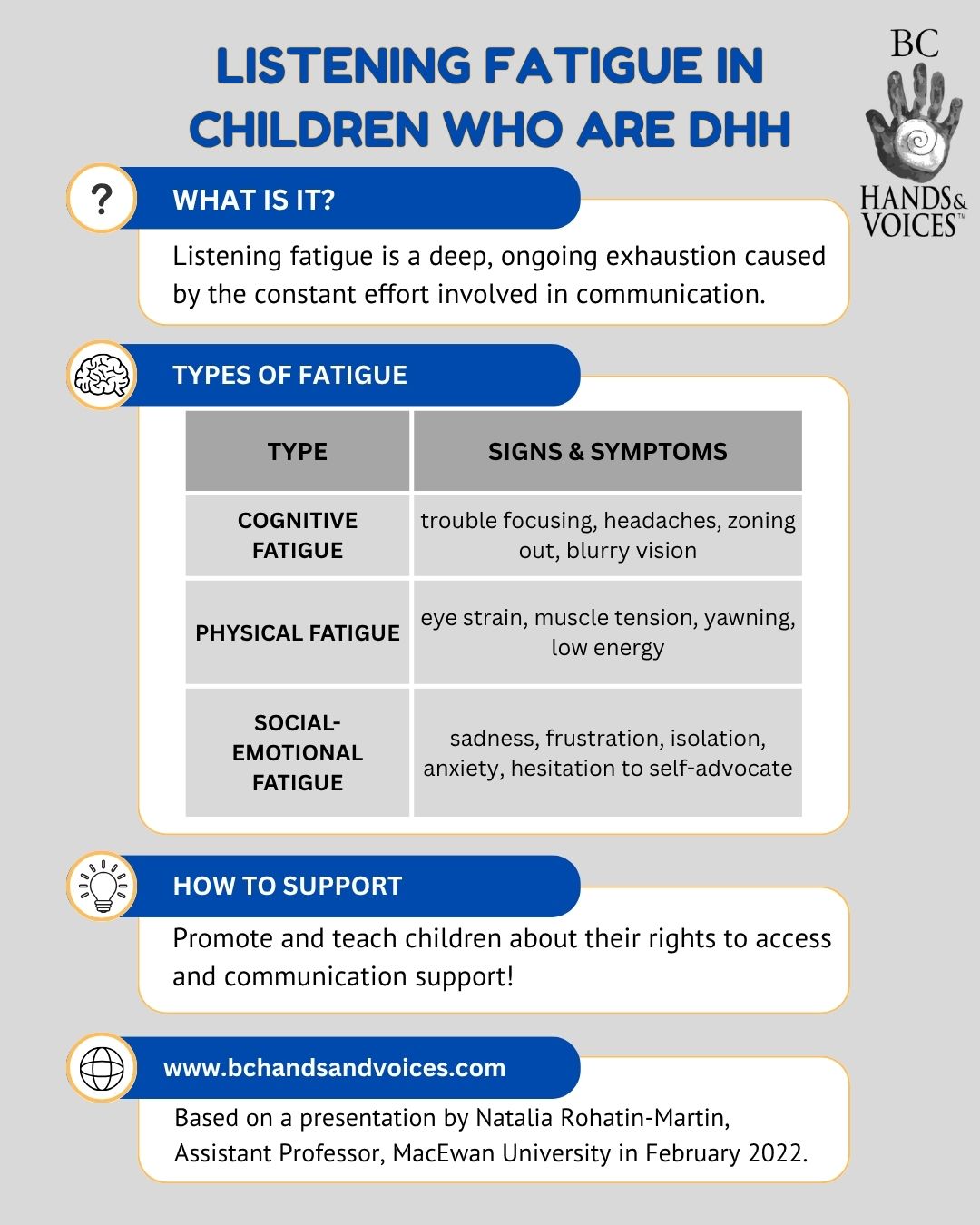
Understanding Listening Fatigue in Children Who Are Deaf or Hard of Hearing

Based on a presentation by Natalia Rohatin-Martin, Assistant Professor, MacEwan University in February 2022.

“I feel bad for students who have to go through this every day… I’m exhausted.”
– A university student after watching a captioned video with no sound for the first time.

This powerful reflection highlights an often invisible challenge our deaf and hard of hearing (DHH) children face daily: listening fatigue. Dr. Natalia Rohatin-Martin, Assistant Professor at MacEwan University, shares research and lived experiences to shed light on this complex and misunderstood issue.

What is Listening Fatigue?

Fatigue isn’t just feeling tired—it’s a deeper, ongoing sense of exhaustion that isn’t solved with sleep. For dhh students, listening and communication require constant cognitive, visual, and social-emotional effort. Imagine trying to track conversations, visual cues, captions, and multiple speakers all at once—for six hours a day.

Unlike typical tiredness, listening fatigue affects concentration, memory, motivation, and even physical health. It can leave children too drained to do homework, socialize, or participate in activities they normally enjoy.

The 3 Types of Fatigue:

  • Cognitive Fatigue
    • Struggles with focus, zoning out, headaches, or blurry vision.
    • May result in missing information or needing frequent repetition. 
  • Physical Fatigue
    • Eye strain, muscle tension (even from signing), yawning, or general low energy.
    • Affects participation in sports, chores, or hobbies. 
  • Social-Emotional Fatigue

    • Feelings of sadness, frustration, isolation, or anxiety.
    • May avoid group work or feel hesitant to advocate for themselves. 

Common Signs Parents Might Notice:

    • Your child comes home quiet or irritable.
    • They want to nap or withdraw from activities.
    • They complain of headaches or eye discomfort.
    • They seem unmotivated to socialize or complete schoolwork. 

How Can We Support Our Kids?

  • Encourage Self-Advocacy
    Help your child understand their right to communication access. Practice asking for repetition, requesting that peers face them, or managing technology like FM systems.
  • Teach Recovery Strategies
    Create quiet downtime after school. Prioritize breaks and rest to help your child recharge.
  • Collaborate with Educators
    Share insights about your child’s needs and signs of fatigue. Advocate for flexible seating, reduced background noise, or access to transcripts and captioning.
  • Normalize the Experience
    Let your child know fatigue is valid and real. Build empathy among classmates and teachers whenever possible.

Natalia emphasizes that promoting independence and teaching children about their rights to access and communication support will help them manage fatigue more effectively. Her informative video is a helpful resource for parents, educators, and anyone supporting a child who is dhh. It offers not only valuable insights but practical strategies to reduce fatigue and foster a more inclusive learning environment.

? Watch the full video presentation here: https://www.youtube.com/watch?v=UOn8fJ_E2Lc


Posted in Articles | Comments Off on Understanding Listening Fatigue in Children Who Are Deaf or Hard of Hearing

What the Invictus Games Taught Me

By Jen Gow 

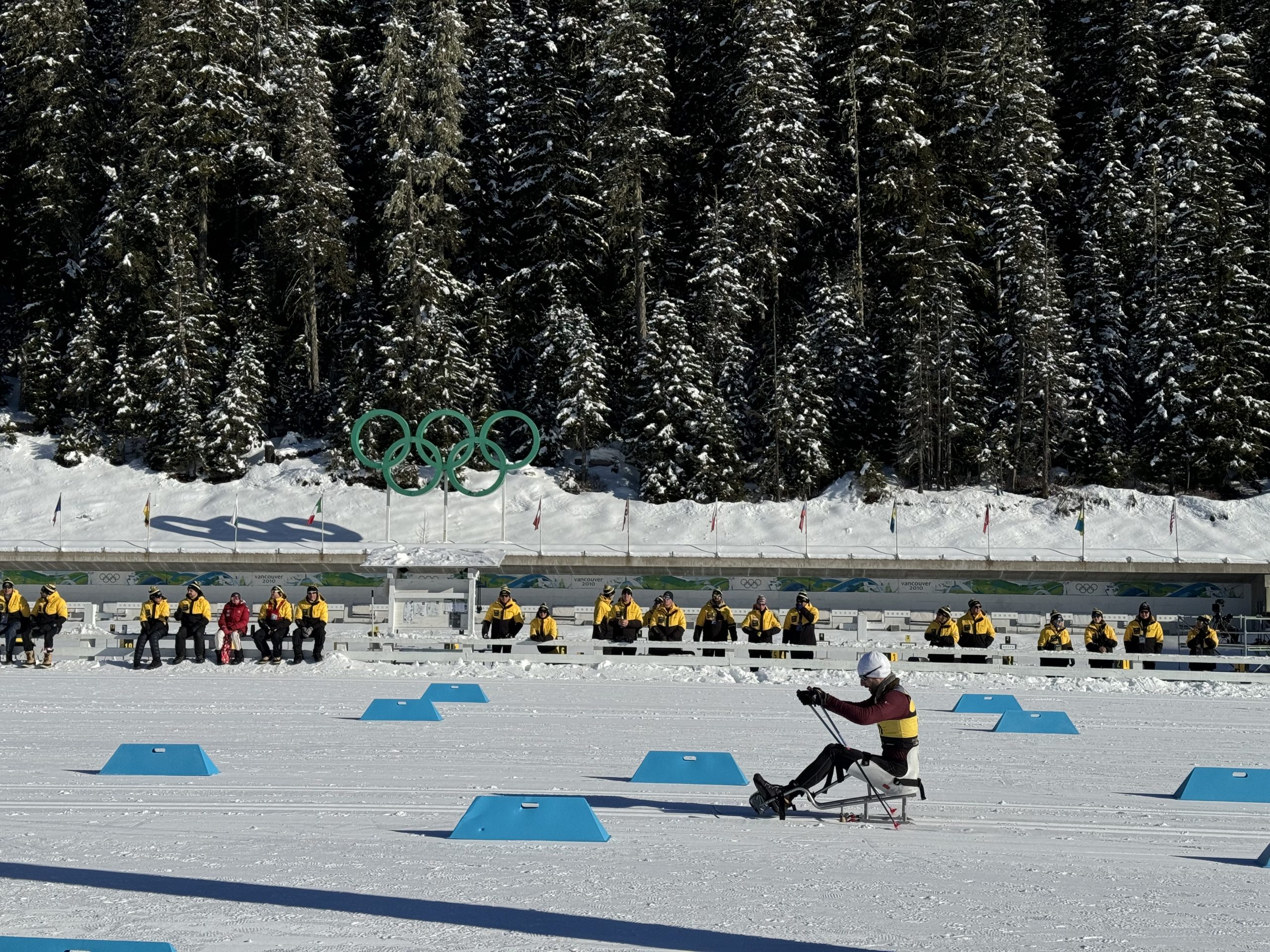
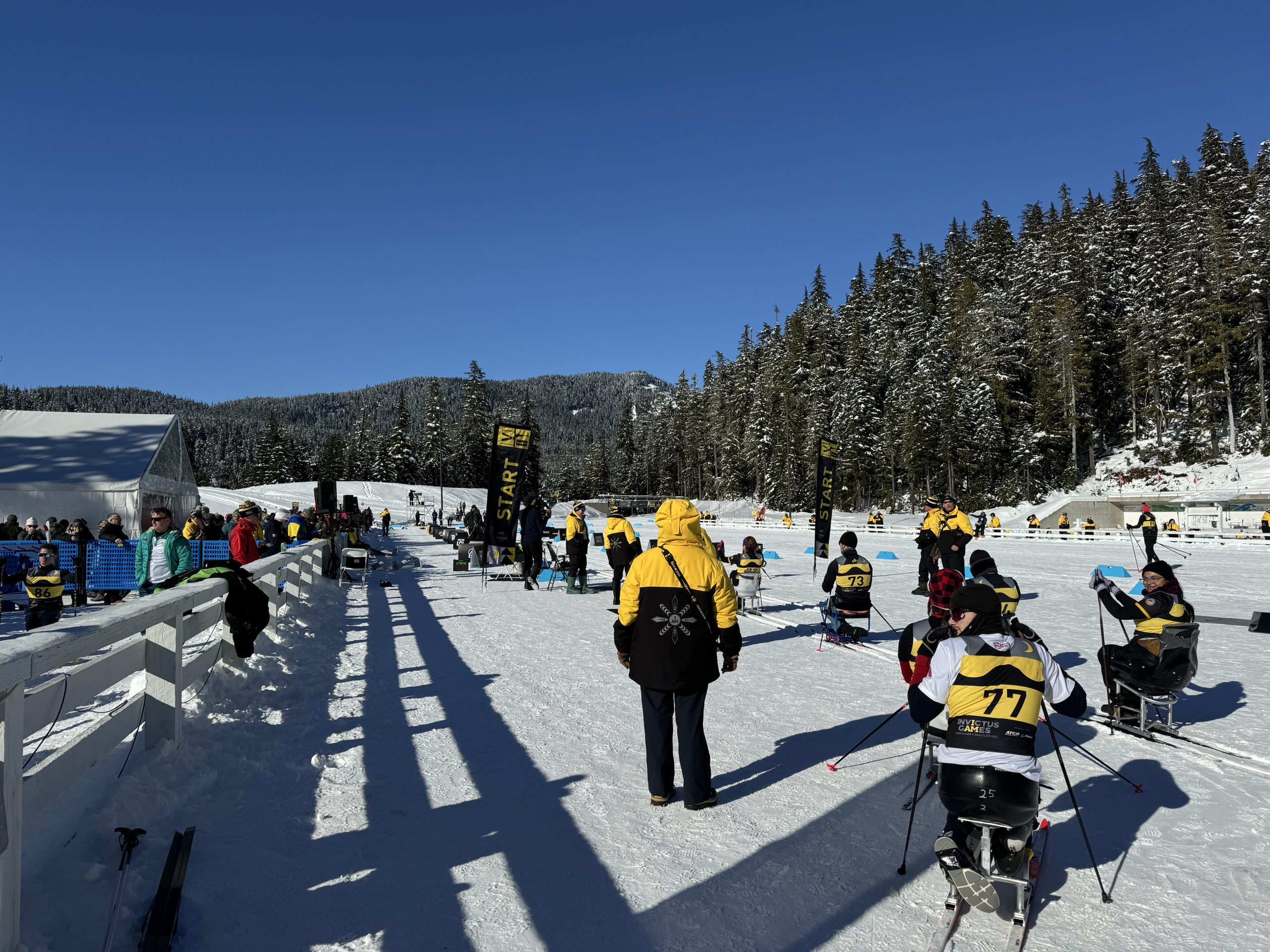
I had the privilege of volunteering at the Invictus Games in Whistler this past February. My family and I are involved in the cross country ski community and I often officiate at races. You can usually find me at the start line, helping to set athletes up for a strong start to their race. The Invictus Games were a perfect opportunity for me to put my skills to use.

  

The preparation for an international event like this takes a huge commitment from a large number of people; a process that starts years before and intensifies in the months and then the weeks leading up to the event itself. My role was small; nevertheless, I had to sign up many months in advance, go through safety checks and Invictus Games training, in addition to the technical sports officials training I already held.

The anticipation was palpable in the days leading up to the cross country skiing and biathlon events I was helping with. Mother Nature delivered outstanding conditions, with pristine snow and perfect cold sunny winter weather. Participants took part in a practice and orientation day prior to their events so they could ski the course and try the rifle shooting range. While some were experienced skiers, for others it was their first time on skis! Not only were they putting themselves out there to try something new, they were doing it while being filmed for worldwide TV coverage!
Cross Country Skiing was the first event, where skiers were challenged to push themselves through demanding conditions using adaptive techniques. Biathlon followed, with its skiing and rifle shooting stages. How many of five targets are missed determines the number of penalty loops an athlete has to ski. I believe biathlon was the most popular event at the Games; perhaps not a surprise given the shooting skills of many of the participants.
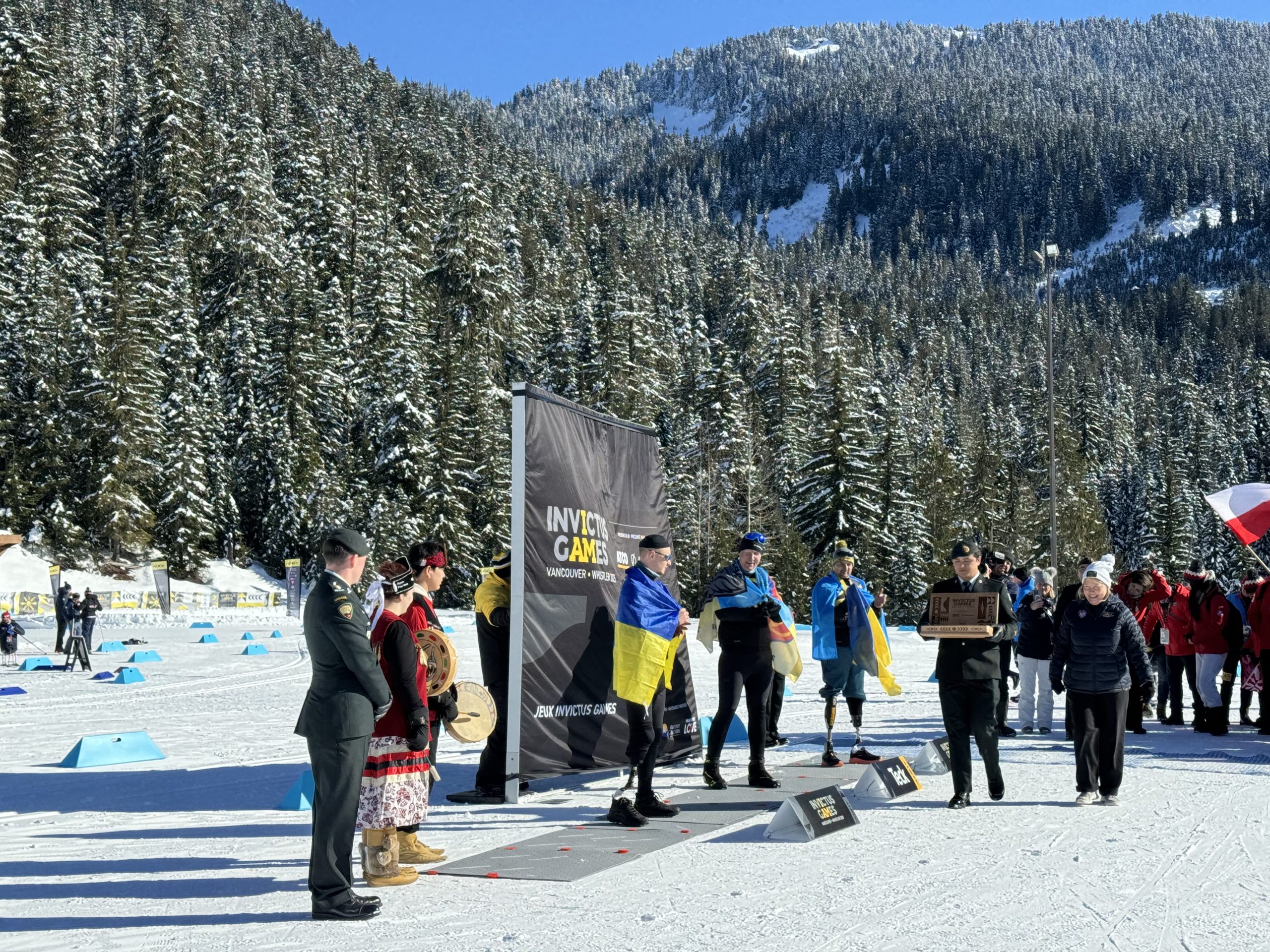
Reflecting on my experience, it struck me how many parallels there are between the Invictus Games and Deaf and Hard of Hearing community events, with both creating valuable opportunities for low incidence groups to come together to create community.

When I spoke with the chairman of the Invictus Games, Lord Allen of Kensington, he shared with me that one area where the Games have their biggest impact is breaking down isolation and loneliness by creating opportunities where participants can come together. By doing this in settings where barriers have been removed, participants can test their true limits and rediscover their confidence and self-worth.

Like the wounded, injured and sick service members participating in the Invictus Games, our d/deaf and hard of hearing (dhh) children are not alone. Our families may not live on the same street, in the same neighbourhood or even in the same town but there are many of us spread across the province and beyond. We may not get the chance to ‘bump into’ one another so we need to make a concerted effort to bring our children and ourselves together. 

The Invictus Games reminded me of the value in doing that. At our local, regional races, there are often just a few para-athletes; perhaps two or three sit skiers and one or two visually impaired skiers. At the Invictus Games, however, I had the pleasure of seeing these athletes together in large numbers where they were no longer the minority. The sense of belonging was palpable. I’ve experienced the same at DHH events; feelings of aloneness are broken down, sense of self is boosted and self-esteem and confidence are given a big helping hand. 

As well as bringing the participants together, it also created unique leadership opportunities for local para-athletes, who led the forerunning teams that went out prior to each race to smooth the ski tracks, and who coached the sit skier participants. Similarly, DHH events can create leadership opportunities for DHH adults and youth to be role models to our younger children; people just like them who they can look up to and be inspired by.

The Invictus Games events were set up to be fully accessible to participants, with attention given to every detail, be that adjusting the height of gates at the start line, doing away with podiums for medalists, or providing sit skis, guides and interpreters. By removing barriers to participation and creating an inclusive environment, all participants were able to participate to their full potential. The resulting atmosphere was electric; I could literally feel the buzz of the excitement, joy and exhilaration from the participants. Likewise, ensuring DHH events are fully accessible lets our children know what inclusion really feels like, and helps them to explore their full potential. 

An aspect of the Invictus Games I had not been aware of was that each participant is able to bring two support people with them, be that family, friends or care workers. This holistic model not only supports the participant themself but can bring about healing and reconciliation for all, and a broader feeling of community that includes those they love and those who are important to them. Including other family members in events for our DHH children can also help to foster understanding and inclusivity, and promote family well-being.

The part of the Invictus Games I was involved with was over in a few short days but it was obvious that their impact would last much longer; the events were a launch pad for connectedness, belonging and self-discovery. Regularly attending DHH events with our children can have a similar impact on them.

Just like the Invictus Games, creating events for our deaf and hard of hearing children takes commitment to put ideas into action. Events often happen thanks to dedicated individuals supported by an army of volunteers. Taking part in the Invictus Games reminded me of the value in making time to be part of these events for my DHH child and my family, whether that’s helping to organise or host an event, or to take part in it. Life can often feel full and creating that space isn’t always easy but the Invictus Games reminded me of the importance of being intentional about taking part in DHH community events. I hope you’ll join me!
Posted in Articles | Comments Off on What the Invictus Games Taught Me

Summer Get-Together 2025- 中文 (Chinese)

For our Chinese speaking families.

Please register here: https://tinyurl.com/5bat6ycp


summer-get-together-2025-sc


summer-get-together-2025-tc

Posted in Events | Comments Off on Summer Get-Together 2025- 中文 (Chinese)
    Sign Up for Our eNewsletter!
  • H&V Mission (ASL)

  • Guide By Your Side Program (ASL)

  • Diversity, Equity & Inclusion

    We at H&V are looking within ourselves and within the organization to do better in supporting Black lives Matter. Learn more HERE.

  • Upcoming Events

  • Recent Posts

  • Categories